
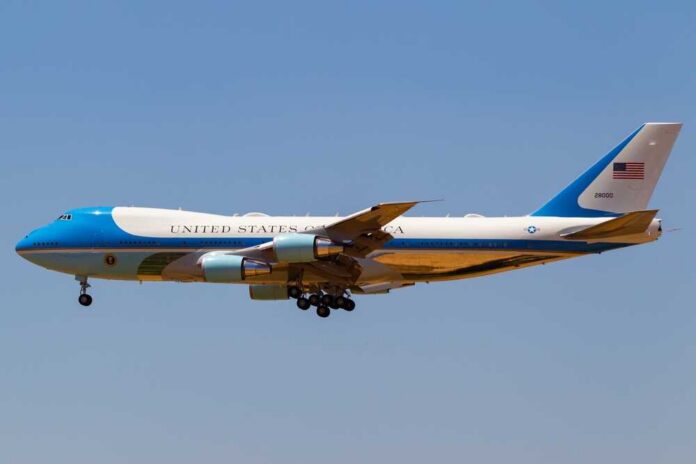
One month after a routine NATO summit in Turkey, we learned the president did not leave the country on the plane everyone watched him board.
Story Snapshot
- President Trump says the Secret Service and the military insisted he leave Turkey on a different plane because of a threat.
- Reporters say he slipped out of Air Force One, hid in a catering truck, and boarded a secret military jet as the decoy took off.
- Security officials viewed the Qatari-gifted presidential jet as less protected than the older Air Force One.
- The episode shows how far American security planners will go to shield a president from Iran and its proxy forces.
A president boards one plane, then vanishes to another
President Trump flew into Ankara, Turkey, for a NATO summit on a sleek new jet gifted by Qatar and used as Air Force One, a symbol of luxury and status that looked made for television.
When departure day came, cameras captured him walking up the famous blue-and-white stairway of the traditional Air Force One, waving as always. That image settled into the public mind. Only later did we learn that the picture was not the full story.
Trump on the Turkey plane change: "I go by Secret Service and the military. They wanted me to go on a different flight, a different plane… I do what they say… I guess there was a threat out there. I didn't really ask too much about it. I get a lot of threats." pic.twitter.com/u5sJ1u02ia
— AZ Intel (@AZ_Intel_) August 12, 2026
Minutes after that wave, according to reporting based on United States officials, Trump quietly climbed down inside the airport and slipped into an airport catering truck that rolled to a different aircraft parked away from view.
Inside that truck, the commander in chief was more cargo than dignitary, moved under cover while the world believed he sat in a leather seat on the larger jet. The traditional Air Force One took off as a decoy, while the real president sat somewhere else in the sky.
The threat that turned Air Force One into a decoy
What pushed security planners to treat Air Force One like a lure instead of a shield was not a vague worry. The Washington Post reported that United States intelligence picked up an Iranian assassination threat against President Trump tied to the war with Iran and its proxy networks.
Other outlets described concern about missile or proxy attacks aimed at the Qatari-gifted plane, which lacked the full defensive systems of the older presidential aircraft. This matches a simple truth: enemies take aim at leaders who stand up to them.
Officials quoted in coverage said the United States Secret Service urged Trump not to leave Ankara on the newer jet and instead use the older Air Force One, which has hardened communications and proven defenses.
That recommendation fits the agency’s core mission: protect the president first, comfort and image second. Critics may grumble about theatrics, but common sense says you listen when the people paid to stop bullets and missiles tell you to move.
Trump’s own story: “They wanted me on a different plane”
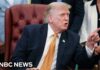
Weeks after the episode, Trump gave his public version. He said the Secret Service and the military wanted him on a “different plane” because of a threat and that he went along, stressing that he was not personally scared and suggesting he had little real choice.
He framed the decision as following expert advice, not seeking drama. That tone fits his longstanding message to voters: toughness on hostile regimes without drama over personal risk.
Trump also downplayed the idea that the switch was about a specific assassination plot, with some outlets quoting him saying the move had nothing to do with security concerns while anonymous officials insisted it did.
Here the record shows a familiar Washington split: public comments stay vague, anonymous briefings fill in the harsher details, and the truth sits somewhere between.
How far security planners go to keep a president alive
Former agents and security experts said this kind of quiet plane swap is unusual but not unheard of when threats spike.
The plan they built in Turkey looked almost like a movie script: a visible decoy aircraft, a hidden transfer in a catering truck, a second jet with a different flight path, and a White House press operation telling the world the president was on Air Force One while he was not.
The point was simple: make it harder for Iran or its proxies to target the man who orders strikes and sets sanctions.
That level of deception bothers some observers, who worry about public trust when a president’s location is misrepresented. Yet the facts support a more sober view. Classified threats, especially from regimes like Iran, often require short-term secrecy that conflicts with complete transparency.
Unanswered questions and what accountability should look like
Not every detail of the Turkey switch is clear. Agencies have not released the protective movement orders, the full threat assessment, or the exact chain of command that approved the aircraft changes. Some outlets frame the episode as an “abundance of caution,” others as a direct response to a focused Iranian plot.
That split encourages people to pick the version that fits their politics, but it does not erase the core fact that intelligence flagged danger and security professionals reacted.
Secret Service just smuggled Trump out of Turkey in a catering truck while Air Force One flew as a decoy.
Real Iranian threat. Real protection.
They did the same for Clinton in 2000. Nobody cried then.But now the left and media are quietly seething that it worked.
They didn’t… pic.twitter.com/JVwVzJ5BPP— Robert Toney (@RobertJoeToney) August 12, 2026
Serious oversight should focus on documents, not speculation. Congress can demand the Secret Service, the White House Military Office, and the Defense Department explain why the Qatari-gifted aircraft was judged less safe, what intelligence drove the decoy plan, and whether similar tactics might be used again.
Those answers matter to every citizen, because they define how far our government will go to protect elected leaders in an age when hostile nations openly test American resolve.
Sources:
apnews.com, nytimes.com, washingtonpost.com, theguardian.com, youtube.com, nbcnews.com