A federal judge just drew a hard line around President Donald Trump’s January 6 pardons—and left the alleged D.C. pipe bomber standing on the wrong side of it.
Story Snapshot
- The judge ruled that alleged pipe bomber Brian Cole Jr. is not covered by Trump’s Jan. 6 pardons.
- The Justice Department argued the mass pardon never applied to uncharged, pre-Jan. 6 bombing conduct.
- Cole’s lawyers claim his alleged Jan. 5 bombs are “inextricably linked” to the Jan. 6 events.
- The fight exposes how vague, blanket pardons can fuel years of legal and political warfare.
What Trump’s January 6 pardon really covered
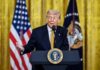
President Trump’s second-term clemency order was not a casual gesture. On January 20, 2025, he signed a sweeping proclamation granting full pardons or sentence cuts to nearly sixteen hundred people tied to the January 6 Capitol events, and ordering prosecutors to dismiss pending January 6 indictments.
The text focused on “offenses related to events that occurred at or near the United States Capitol on January 6, 2021,” drawing a circle around that date and that location.
That circle mattered. The Justice Department and the Office of the Pardon Attorney built their implementation rules around those words: the person had to be convicted of, or at least charged with, offenses related to those Capitol events to qualify for relief.
Federal records and later congressional reports describe the recipients as rioters, conspirators, and others whose cases clearly flowed from the breach of the building, not from separate plots days earlier or miles away.
Who Brian Cole Jr. is and what he is accused of
Brian Cole Jr., a thirty-year-old Virginia man, was arrested in December 2025 and charged with interstate transportation of explosives and malicious attempt to use explosives.
Prosecutors say he planted two pipe bombs outside the Republican National Committee and Democratic National Committee headquarters in Washington, D.C. on the night of January 5, 2021, the eve of the riot. Cole has pleaded not guilty. His lawyers deny he planted the bombs at all, while at the same time insisting that, if he did, Trump already wiped the slate clean.
That double track is common in high-stakes criminal cases: deny the facts, but also argue that the law would excuse them even if they were true.
The move matters here because the alleged bombs were discovered on January 6 and forced law enforcement to divert resources while the Capitol was under attack. That timing is the entire backbone of Cole’s argument that his case is part of the same story as the riot, not a side episode.
How the Justice Department framed the limit of the pardon
The Justice Department’s view is blunt: the pardon does not touch Cole. In a filing to the federal court in Washington, prosecutors said Trump’s proclamation only covered two groups—people already convicted, and people already charged in pending January 6 cases, as of January 20, 2025.
Cole, they stressed, was in neither group. He was not indicted until late 2025, almost a year after Trump signed the proclamation.
Prosecutors also argued that Trump’s order never embraced violent acts like planting bombs at party headquarters, even if they happened nearby in time or space. Officials cited the “clear and unambiguous” wording that ties relief to “events at or near the United States Capitol on January 6,” not to every crime that might have helped set the stage.
That narrow reading lines up with earlier Justice Department positions that the mass pardon did not spill over into unrelated firearms cases or other crimes that happened in different places or on different days.
The defense theory: ‘inextricably linked’ to January 6
Cole’s lawyer, Mario Williams, is betting on the word “related.” In court papers and television interviews, he argues that Cole’s alleged conduct is “inextricably and demonstrably tethered” to the events at the Capitol on January 6.
The bombs, he says, were discovered that day, drew federal agents away from the Capitol, and formed part of a broader pattern of pressure on Congress, even if they were planted a day earlier.
Judge says alleged D.C. pipe bomber Brian Cole Jr. isn't covered by Trump's Jan. 6 pardons. pic.twitter.com/hgSpjRgYxg
— super dlcs (@superdlcs) July 7, 2026
Williams also leans on the Justice Department’s own past statements. In other January 6 cases, the department has accepted that Trump’s pardon can apply before conviction and can reach pending cases that had not yet gone to trial.
From there, the defense stretches the logic: if timing of conviction is not required, then timing of indictment should not be a hard barrier either, as long as the facts are “tethered” to the Capitol attack. That is a creative argument, but it runs straight into the plain dates written into the proclamation and the government’s administrative rules.
Why the judge sided with the Justice Department
The judge’s ruling cut through the rhetoric. By agreeing with the Justice Department that Trump’s proclamation is “irrelevant” to Cole’s case, the court accepted three key ideas: Cole was not in the defined group when the pardon issued, his charges do not fall inside the text’s focus on January 6 at the Capitol, and the president never said his clemency covered future indictments.
That is a classic conservative reading of law: stick to the words on the page, not the stories lawyers spin around them.
From a common-sense standpoint, that approach tracks. A president can forgive a set of known offenders without unknowingly wiping out every possible related crime that surfaces years later. Otherwise, a blanket pardon becomes a blank check for unknown actors.
For Americans who value both law and order and a strong presidency, the message is simple: the pardon power is broad, but it is not magic. When a proclamation names a date, a place, and a class of people, courts are right to treat those limits as real.
Sources:
cbsnews.com, en.wikipedia.org, facebook.com, themarshallproject.org, whitehouse.gov, docs.house.gov