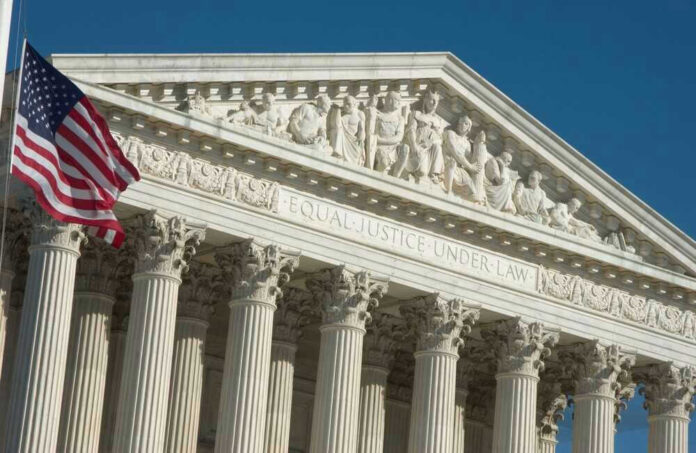
The Supreme Court just hit a record-low approval rating at the very moment it crossed President Trump on tariffs, birthright citizenship, and the Federal Reserve — and that collision tells us more about our politics than about the Constitution itself.
Story Snapshot
- Only about one-third of Americans now approve of the Supreme Court’s work, a new record low.
- Republican approval of the Court has fallen sharply after key rulings against Trump’s agenda on tariffs and citizenship.
- Public trust in the Court has been sliding for years, with deep partisan gaps shaping how each decision is received.
- The 2026 term shows the justices checking presidential power while getting hammered in the polls for it.
Record-low approval and a sudden Republican chill
Gallup’s latest numbers are blunt: just 33 percent of Americans approve of the job the Supreme Court is doing, while 61 percent disapprove. That approval share is down six points from 39 percent in July 2025, which itself was the prior low in Gallup’s 26-year trend.
Media summaries repeat the same headline: we are dealing with the least popular Supreme Court Gallup has ever measured, and the pain is not evenly spread across the parties.
Supreme Court approval hits record low as Republicans' support declines https://t.co/3aEWQziDNn
— CNBC Politics (@CNBCPolitics) July 28, 2026
Gallup’s write-up points to Republicans as the key story. Republican approval of the Court dropped to 58 percent, down from a near-record high of 79 percent in the last measurement. That is a massive swing inside one party in under a year.
Gallup explicitly suggests the drop “may indicate” that rulings that went against the Trump administration on tariffs and birthright citizenship weighed more heavily in Republican evaluations than rulings that favored President Trump and Republicans.
The long slide in trust and why 2026 is different
This collapse did not come out of nowhere. Gallup and other pollsters have spent years charting a slow erosion of trust in the Supreme Court. Gallup has repeatedly found job approval stuck in the low 40s since 2021, including a 40 percent reading tying earlier record lows.
Pew Research Center reported in 2025 that favorable views of the Court were near a three-decade low, down more than twenty points from 2020. The Court was in rough shape with the public before this term even began.
That broader picture matters for any honest analysis. When an institution is already unpopular, new controversial decisions act like fuel on an existing fire. Gallup has documented huge party gaps in Court approval in recent years, with Republicans often rating the Court far higher than Democrats.
In that environment, one term with high-profile clashes with a sitting president will almost certainly move numbers inside one camp more than it will change minds nationally about judicial craftsmanship.
Tariffs, birthright citizenship, and limits on presidential power
The 2026 term put the Court directly in the middle of Trump’s second-term agenda. One major case struck down his sweeping “reciprocal” tariffs, where the administration tried to impose broad duties on nearly every country using unilateral executive power.
The justices ruled 6–3 that this exceeded presidential authority, reinforcing the idea that Congress, not the White House, controls the core of tariff policy. For conservatives, that sounds less like activism and more like enforcing the separation of powers.
The biggest political flashpoint was birthright citizenship. In Trump v. Barbara, the Court rejected Trump’s executive order that sought to deny automatic citizenship to children born in the United States to parents who were here illegally or only temporarily.
The decision held that such children are “subject to the jurisdiction” of the United States and are citizens at birth under the Fourteenth Amendment’s Citizenship Clause. Multiple outlets described the ruling as a major blow to Trump’s immigration plans, but a firm defense of constitutional text.
The Federal Reserve fight
The term also reached into the Federal Reserve. Reporting on the Court’s agenda noted that the justices were poised to decide Trump’s effort to dismiss a member of the Federal Reserve’s Board of Governors, a move that would have tested the autonomy of the central bank.
The broader theme across these cases is straightforward: the Court is policing the outer edge of presidential power, even when that president is a Republican. For conservatives who care about checks and balances, that should be reassuring, not alarming.
Supreme Court approval hits record low as Republicans’ support declines – CNBChttps://t.co/GVlY4JpAHY
— Open Outcrier (@OpenOutcrier) July 28, 2026
Yet some Republicans clearly read these rulings as political slaps, not constitutional guardrails. That reaction lines up with other polling showing many Americans now think the Court bases decisions on ideology rather than law, especially when Trump’s policies are involved.
From a common-sense standpoint, that is a dangerous way to think about any court. If every defeat for “our side” is proof of bias, then no referee can ever be legitimate, and the rule of law turns into pure team sport.
Politics, perception, and what the numbers really show
The polls measure satisfaction, not legal correctness. Gallup’s questionnaire does not ask whether respondents think Trump v. Barbara was faithful to the Fourteenth Amendment or whether the tariff decision matched the statute; it simply records whether people “approve or disapprove” of the Court’s job performance.
That is valuable for tracking mood, but it tells us more about partisan feelings than about doctrine. The sharp Republican drop, while Democrats and independents mostly held steady, supports that view.
The bottom line is uncomfortable but clear. A Supreme Court that reins in executive overreach on tariffs, defends birthright citizenship grounded in the Constitution’s plain text, and protects the independence of the Federal Reserve is doing the sort of work the Framers expected.
If Republicans sour on the Court mainly because it sometimes says “no” to a Republican president, that is a problem with our politics, not with the Court’s duty to the Constitution.
Sources:
cnbc.com, politicalwire.com, yougov.com, brookings.edu, washingtonpost.com, reuters.com, supremecourt.gov, aljazeera.com, nytimes.com, deseret.com, en.wikipedia.org, scotusblog.com, nbcnews.com