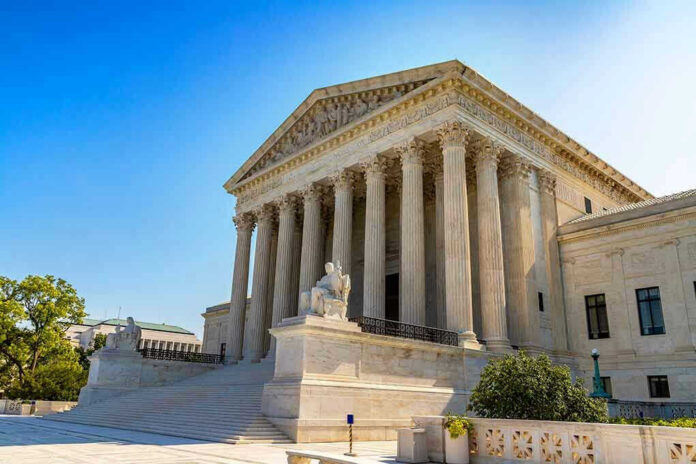
The Supreme Court has cleared Alabama to keep a Republican‑leaning congressional map for 2026, and Democrats are furious because they just lost one of their favorite tools for engineering permanent blue power.[4]
Story Snapshot
- The United States Supreme Court allowed Alabama to use its 2023 House map with only one majority‑Black district, replacing a court plan that had two.[4]
- The decision halts a lower‑court order that accused the Republican‑drawn map of racial discrimination and vote dilution.[4]
- The fight is the latest round in a long war over the Voting Rights Act and partisan redistricting after the Court’s earlier Allen v. Milligan ruling.
- The ruling helps preserve a likely Republican seat in a closely divided House, enraging Democrats and liberal activists.[4]
Supreme Court Stops Lower Courts From Forcing A Second Democrat‑Friendly District
The United States Supreme Court on Monday halted a lower‑court order that would have forced Alabama to use a congressional map with two largely Black districts in this year’s elections, instead allowing the state to rely on the 2023 map drawn by its Republican legislature.[4]
That legislatively enacted plan contains one majority‑Black district and maintains a configuration more favorable to Republicans, effectively undoing a court‑ordered map that would have boosted Democratic prospects.[4]
The order came on an emergency basis ahead of looming election deadlines, a pattern that has become common in redistricting fights where judges and activists attempt to rewrite maps just months before voters head to the polls.[4]
BREAKING — The U.S. Supreme Court allows Alabama to use the new 6R-1D congressional map for the midterm elections.
🔴 +1 GOP
🔵 -1 DEM pic.twitter.com/UZtpM9eeUN— VoteHub (@VoteHub) June 3, 2026
By stepping in now, the Supreme Court ensured Alabama’s voters will cast ballots under boundaries chosen by their elected representatives rather than by a panel of unelected federal judges.[4] The Associated Press explains that the Court’s action “set the stage for Alabama to eliminate one of two largely Black congressional districts before this year’s elections,” reverting to a single majority‑Black seat that has long been the norm in the state.[4]
Video coverage likewise reports that the justices reinstated the 2023 map with one majority‑Black district, explicitly allowing its use in the upcoming election cycle following the lower court’s earlier block. For conservatives, that means judicial overreach has been checked, at least for now, and the people’s map—not a court‑engineered partisan map—will govern the 2026 contests.[4]
How Allen v. Milligan Spawned A New Round Of Redistricting Warfare
This latest decision grows out of the same redistricting war that produced Allen v. Milligan, where the Supreme Court in 2023 held that Alabama’s 2021 congressional map likely violated Section 2 of the Voting Rights Act by concentrating Black voters into a single district.
After that ruling, civil‑rights plaintiffs and Democratic‑aligned groups pushed aggressively for a map with two Black‑majority or Black‑opportunity districts, arguing that anything less unlawfully diluted Black voting strength.
Alabama’s Republican legislature responded by passing a revised 2023 plan that still included only one majority‑Black district but adjusted other lines, contending that the new configuration complied with the Voting Rights Act while preserving traditional criteria such as compactness and respect for county boundaries.[4]
A three‑judge federal panel, however, rejected that argument, declared the map unconstitutional and intentionally discriminatory, and attempted to impose its own version with two heavily Black districts—setting up the clash the Supreme Court just resolved for this election.[4]
Neutral observers have noted that these disputes have become a recurring feature of modern redistricting, especially in Southern states where partisan competition and racial demographics are closely linked.
The League of Women Voters describes the Alabama saga as a sequel to Milligan and part of a broader pattern in which plaintiffs test the outer limits of Section 2 to demand additional minority‑leaning seats, while states insist they retain some discretion to draw politically coherent districts without treating race as the only factor.
Election calendars add more fuel to the fire: courts face hard deadlines for candidate filing and ballot printing, which often pushes the Supreme Court to intervene through fast, unexplained orders that settle which map will be used in the short term, even while litigation technically continues.[4]
That emergency posture means the public frequently experiences these decisions not as long legal opinions, but as sudden, high‑stakes rulings that can shift one or two seats in a narrowly divided House.
Democrats Decry ‘Racial Discrimination’ While Conservatives See A Win For Voters
Liberal outlets reacted to the ruling by branding Alabama’s 2023 plan “racially discriminatory” and complaining that the Court had green‑lit a map “favoring Republicans” in apparent defiance of the lower‑court record.[4]
Commentators highlighted accusations from the three‑judge panel that the legislature “well knew” a map without a second Black district would dilute Black voting power, using this language to frame the Supreme Court’s order as a setback for civil‑rights protections and the Voting Rights Act.[4]
Yet the Court’s decision does not erase Section 2 or blessing racial discrimination; it simply restores the state’s chosen map while the legal fight continues, rather than locking in a judicially crafted plan that conveniently creates another safe Democratic seat.[4]
For conservatives, the case underscores how often “voting rights” rhetoric masks a straightforward partisan project: converting population patterns into permanent Democratic control through courtroom maneuver instead of persuading voters at the ballot box.
The Institute for Public Policy and Social Research’s Partisan Advantage Tracker illustrates why these fights are so intense: even a single seat can tip control of the House when maps are engineered to turn small vote margins into durable majorities.[1]
The tool shows how different district configurations translate vote totals into seats, highlighting how a “fair” distribution can be skewed when boundaries are drawn to pack or crack certain voters.[1] Alabama’s restored 2023 map is one piece of that national puzzle, reinforcing a Republican‑leaning configuration in a state where voters already give Republicans a strong statewide edge.[1][4]
For Trump‑era conservatives worried about weaponized courts, open borders, runaway spending, and the erosion of constitutional limits, the Supreme Court’s decision is another reminder that personnel and precedent matter—and that keeping control of the judiciary is just as crucial as winning any single election.
Sources:
[1] Web – BREAKING: Supreme Court Allows Alabama to Use Congressional Map that …
[4] YouTube – Supreme Court rules on Alabama congressional map