
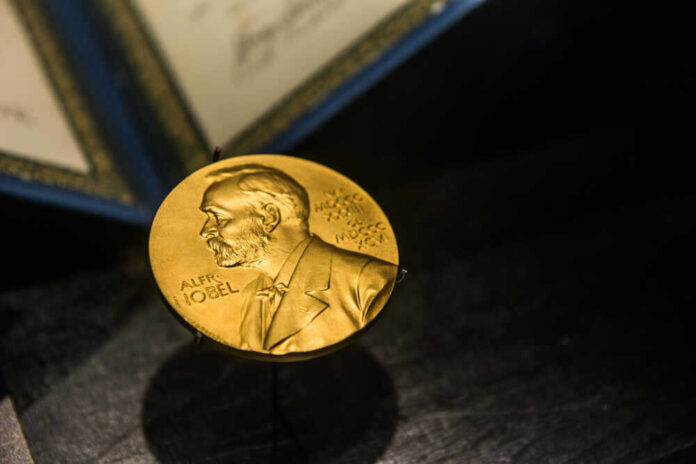
President Trump accepts a Nobel Peace Prize medal from a Venezuelan leader.
Story Snapshot
- Trump receives the Nobel Peace Prize medal from Venezuelan opposition leader Machado.
- Machado acknowledges Trump’s role in the capture of Nicolás Maduro.
- Controversy arises due to the Nobel Committee’s rules against sharing medals.
- Event highlights ongoing U.S. involvement in Venezuela’s transition.
Trump Receives Nobel Medal from Machado
On January 15, 2026, President Donald Trump received a Nobel Peace Prize medal from Venezuelan opposition leader María Corina Machado in a closed-door meeting at the White House. Machado, who won the Nobel Peace Prize in 2025 for her efforts in promoting democracy in Venezuela, presented the medal to Trump as a gesture of gratitude for his administration’s role in capturing former Venezuelan leader Nicolás Maduro. The event drew significant attention due to the Nobel Committee’s rules, which prohibit the sharing or transfer of the award.
Trump expressed his appreciation on Truth Social, describing the handover as a “wonderful gesture of mutual respect.” Machado echoed this sentiment, stating that the medal recognized Trump’s commitment to Venezuelan freedom. The symbolism of the event was not lost on observers, as it invoked historical U.S.-Venezuela camaraderie, reminiscent of the Lafayette-Bolívar medal exchange two centuries ago. However, the unusual nature of the medal transfer has sparked debate over its legitimacy.
Machado’s Motivations and U.S. Strategy
María Corina Machado, a pivotal figure in the Venezuelan opposition, has been an outspoken advocate for democratic reforms. Her decision to present the Nobel medal to Trump underscores her gratitude for the U.S. intervention that led to Maduro’s capture. Machado’s move aims to solidify international support for Venezuela’s transition to democracy. Despite her noble intentions, the Nobel Committee has reiterated that the prize cannot be shared or transferred, adding layers of complexity to the situation.
For President Trump, this gesture serves as a validation of his foreign policy achievements and bolsters his long-standing pursuit of a Nobel Prize. The capture of Maduro, orchestrated by U.S. forces, has positioned Trump as a key player in Venezuela’s future. Yet, while the medal presentation highlights U.S. support for democracy, it also raises questions about Machado’s leadership capabilities, especially as Trump remains skeptical of her domestic backing.
US president Trump accepts Nobel Peace Prize medal from Venezuelan opposition leader Machado. pic.twitter.com/rR08i6RTER
— Current Report (@Currentreport1) January 16, 2026
Implications for Venezuela’s Future
The exchange of the Nobel medal carries significant implications for Venezuela’s political landscape. In the short term, it strengthens Trump’s image and reaffirms U.S. commitment to supporting democratic transitions. However, by not fully endorsing Machado as a leader, the U.S. risks creating a power vacuum that could destabilize the region. Long-term stability in Venezuela hinges on establishing a clear and recognized leadership that can guide the nation out of its current crisis.
Amid these developments, the Venezuelan people remain hopeful for a brighter future. Economic reforms, such as the potential privatization of PDVSA, offer a path to recovery. The push for democratic governance resonates with many citizens who have long suffered under authoritarian rule. The international community will closely watch how these events unfold, as they may set a precedent for U.S. involvement in similar situations worldwide.
Sources:
Trump accepts Nobel Peace Prize medal from Venezuelan opposition leader Machado
Maria Corina Machado presents Nobel medal to Trump
Trump’s meeting with Machado and Venezuela’s future