

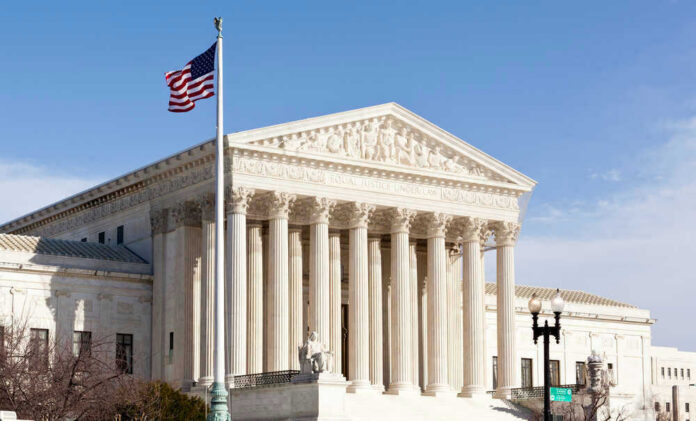
The Supreme Court appears ready to strike down President Trump’s executive order limiting birthright citizenship, potentially dealing a significant blow to his administration’s efforts to curb illegal immigration and restore constitutional sovereignty over who becomes an American citizen.
Story Snapshot
- Supreme Court justices expressed deep skepticism toward Trump’s executive order restricting birthright citizenship during April 1, 2026 oral arguments in Trump v. Barbara
- President Trump’s executive order reinterprets the 14th Amendment to exclude children born to illegal immigrants and temporary visitors, aiming to end “birth tourism” and anchor baby practices
- The administration argues the order restores the original 1868 understanding requiring parental “domicile” for citizenship, while opponents claim it violates 128 years of settled precedent
- A ruling against the order could affect millions of families and cement broad birthright citizenship, undermining efforts to control immigration through citizenship reform
Trump’s Constitutional Challenge on Trial
President Trump attended Supreme Court oral arguments on April 1, 2026, as Solicitor General D. John Sauer defended his executive order reinterpreting the 14th Amendment’s Citizenship Clause.
The administration contends that “subject to the jurisdiction thereof” requires parental domicile—lawful permanent presence and intent to remain—excluding children of illegal immigrants and tourists.
Sauer argued that unrestricted birthright citizenship “demeans” this “priceless gift” and cited the 1898 Wong Kim Ark case as supporting domicile requirements. Lower federal courts, including in New Hampshire, previously blocked the order as unconstitutional, setting up this high-stakes showdown before the nation’s highest court.
Historical Precedent Under Scrutiny
The 14th Amendment, ratified in 1868 to overturn Dred Scott and grant citizenship to freed slaves, states all persons born in the United States “and subject to the jurisdiction thereof” are citizens. The 1898 Wong Kim Ark decision affirmed citizenship for a child born to legal Chinese residents, emphasizing broad application of birthright citizenship.
However, the 1884 Elk v. Wilkins case denied citizenship to Native Americans due to tribal allegiance, creating precedent for jurisdictional exclusions. Trump’s order attempts to leverage this historical interpretation, arguing the Founders never intended citizenship for children whose parents owed no allegiance to America.
Critics counter that Wong Kim Ark settled this debate, establishing that physical presence at birth, not parental legal status, determines citizenship.
Breaking News: Key Supreme Court justices appeared skeptical of President Trump’s efforts to limit birthright citizenship during oral arguments. Follow updates here. https://t.co/G7lfh29XmN
— The New York Times (@nytimes) April 1, 2026
ACLU and Allies Mount Constitutional Defense
The ACLU, Legal Defense Fund, Asian Law Caucus, and Democracy Defenders Fund challenged the order in Trump v. Barbara, with attorney Cecillia Wang arguing it creates a “permanent underclass” violating equal protection. Wang asserted even Congress lacks authority to limit citizenship for children of birth tourists, positioning birthright citizenship as untouchable.
The ACLU expressed confidence the Court will strike down what they characterize as an assault on fundamental American values and a cornerstone of democracy.
This framing ignores legitimate concerns about sovereignty and the exploitation of birthright citizenship through illegal immigration and birth tourism, practices costing taxpayers billions while undermining immigration law enforcement and border security.
Justices Signal Doubts About Administration’s Position
Media reports from CBS News and legal analysts reviewing oral arguments indicated multiple justices appeared skeptical of the administration’s interpretation, questioning whether executive action can override established precedent without congressional legislation.
Justice Kavanaugh reportedly pressed Wang on whether Congress could impose any limits, suggesting openness to legislative solutions while doubting executive authority. The skepticism suggests the Court may view Trump’s order as executive overreach regardless of the merits of citizenship reform.
For conservatives frustrated by anchor babies draining resources and birth tourism exploiting American generosity, this potential outcome represents judicial resistance to common-sense sovereignty restoration that most Americans support according to polling data.
Stakes for Immigration Policy and National Sovereignty
A ruling against Trump’s order would cement broad birthright citizenship for generations, affecting millions of families and eliminating executive tools to address immigration-driven citizenship abuse. The decision carries profound implications for border security, fiscal sustainability, and national identity in an era when Biden-era open border policies flooded the country with illegal immigrants.
Conservatives argue the original constitutional understanding supported citizenship limits based on parental allegiance, making Trump’s order a legitimate restoration rather than a radical reinterpretation. The administration positioned the reform as essential to preserving citizenship’s value and ending the magnet effect that incentivizes illegal border crossings.
The Court’s pending decision will determine whether the President retains constitutional authority to defend American sovereignty or whether unelected judges will continue imposing unlimited birthright citizenship contrary to the Founders’ intent and the American people’s will.
Sources:
Mike Davis: Sanity Must Be Restored to Birthright Citizenship – Fox News
Supreme Court Trump Birthright Citizenship Arguments – CBS News
The Key Arguments in the Birthright Citizenship Case – SCOTUSblog