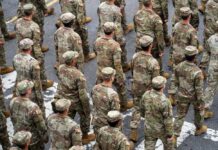
Even in President Trump’s second term, the fact that America’s attorney general needed to move onto a guarded military base shows how fast political anger and foreign criminal threats can collide in Washington.
Quick Take
- Attorney General Pam Bondi reportedly left her Washington, D.C., apartment for military housing after threats tied to drug cartels and backlash over Epstein-related files.
- Reports connect a surge in cartel threats to the Trump administration’s January 2026 capture of Venezuelan leader Nicolás Maduro.
- The New York Times-framed reporting describes a broader trend of Trump officials using military housing for security, even without military backgrounds.
- Costs and reimbursement details remain uneven across officials, fueling criticism about transparency and taxpayer exposure.
Bondi’s move reflects a security climate that is no longer theoretical
Attorney General Pam Bondi reportedly relocated to housing on a nearby military base after federal law enforcement flagged threats aimed at her staff.
Multiple outlets, citing the same underlying reporting, say the threats came from two directions: foreign-linked criminal networks and domestic critics angered by how the Justice Department has handled the Jeffrey Epstein files. Bondi’s office did not publicly clarify what the move costs or whether it is reimbursed.
Pam Bondi has reportedly relocated to a military base due to recent threats. In October, Atlantic staff writers reported that a growing list of senior Trump-administration political appointees were living in D.C.–area military housing: https://t.co/8qrRYBq31P
— The Atlantic (@TheAtlantic) March 11, 2026
Reports also tie the timing of the threat escalation to the Trump administration’s January 2026 capture of Venezuelan leader Nicolás Maduro, an event said to have intensified cartel attention and retaliation risk.
That linkage matters because it connects a national-security action abroad with immediate personal-security consequences at home. The reporting does not provide specific threat details publicly, which is common in protective-security matters, but it confirms law enforcement treated the warnings as credible.
Why military housing is becoming the default “safe zone” for top officials
Military installations near Washington—such as Fort McNair and Joint Base Myer–Henderson Hall—offer a security posture that most civilian neighborhoods cannot match: controlled access points, armed guards, and established protective procedures.
The New York Times-focused storyline portrays Bondi’s move as part of a wider shift in how the administration protects senior appointees amid a higher baseline of threats. The key controversy is not that officials need protection, but where that protection is being provided.
Past administrations have placed certain high-profile officials in secure government housing at times, and prior Trump-era examples have existed as well. The recent reporting, however, describes the second Trump administration as the first to see “widespread” use of military housing by political appointees who do not have direct military ties.
That distinction is central to the debate: military family housing and base residences were built for defense community needs, and expanding access raises questions about capacity and precedent.
Comparable cases show uneven cost rules and mixed public explanations
Other senior figures cited in the reporting include White House domestic policy adviser Stephen Miller, who reportedly relocated after an incident involving confrontation at home.
Defense Secretary Pete Hegseth reportedly moved into a Fort McNair residence with a published monthly payment figure of $4,655.70. Secretary of State Marco Rubio is also described as living on “Generals’ Row.” Each case is presented as security-driven, but the details vary enough to invite scrutiny.
Former DHS Secretary Kristi Noem became a flashpoint after reports characterized her Coast Guard housing as “rent-free,” followed by later testimony that she paid.
That kind of back-and-forth matters because it’s where public trust either tightens or snaps: if the policy is legitimate, clear reimbursement standards and consistent reporting should be easy. If the policy is improvised, then Congress and taxpayers are left guessing, and “security” becomes a blanket justification that can’t be evaluated.
The constitutional tension: security needs versus government normalization
None of the reporting suggests Bondi or other officials surrendered constitutional protections; the immediate issue is physical safety. Still, the story intersects with a broader American concern: when threats become routine, extraordinary security measures can also become routine.
Conservatives have long warned that fear can be used to expand government power and normalize restricted access to leaders. When officials move behind gates, the public sees less transparency, fewer spontaneous interactions, and more bureaucracy layered between citizens and decision-makers.
At the same time, the reported threats underline an ugly reality: political violence and intimidation tactics—whether from foreign criminal actors or unhinged domestic agitators—do not strengthen “accountability.” They corrode it.
The available information does not quantify how widespread the threat environment is, or how many resources were redirected from military housing availability. What is clear is that the administration is balancing security against optics, and critics are using cost ambiguity as their leverage point.
Sources:
Pam Bondi moves into military base amid threats from cartels and irate Americans: report