Two ancient gold rings surfaced with human bones in Thailand, and their tiny script may redraw a map of early trade.
Story Snapshot
- Thai archaeologists found two gold rings with skeletal remains at Don Yai Thong in Phetchaburi.
- One ring bears characters read as ancient Indian Brahmi script; the other is plain gold.
- Experts date the finds to about 1,900–2,100 years ago, the late prehistoric Iron Age.
- The discovery supports long-distance links between India and mainland Southeast Asia.
Discovery at Don Yai Thong: What Teams Found and When
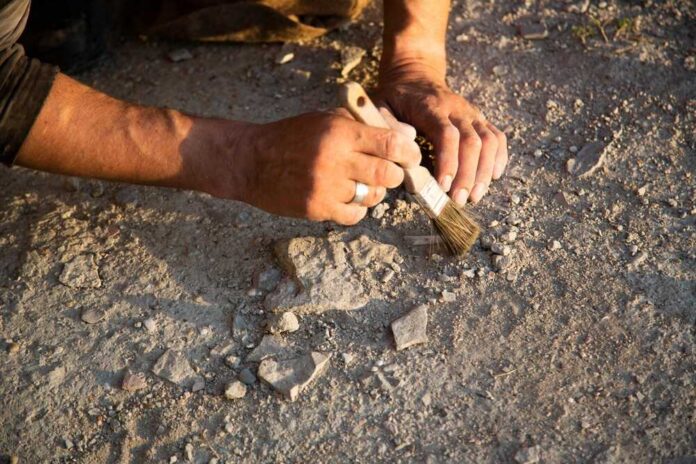
Officials in Thailand’s Fine Arts Department reported that two gold rings were found alongside human bones at the Don Yai Thong archaeological site in Phetchaburi province. The team uncovered the pieces during an ongoing excavation last week.
One ring carries characters that specialists identify as Brahmi, an ancient Indian script. The other is plain. The department said an initial reading points to a phrase tied to Pushya, a lucky zodiac sign in Indian astronomy.
Gold rings around 2,000 years old found at Thail archaeological site https://t.co/0tj6feMkkL
— Express & Star (@ExpressandStar) July 6, 2026
Excavation leaders place the burial in a late prehistoric period also known as the Iron Age in Thailand. That era spans about 1,500 to 2,500 years ago. The site has yielded at least eight human skeletons, bronze and gold jewelry, pottery, and signs of high-status graves.
Crews moved the rings for study and conservation while they continue mapping the cemetery’s layout and recovering fragile materials before seasonal rains raise groundwater levels.
The Script, The Owner, The Meaning: What Early Reads Suggest
Specialists read the inscribed ring as “the one protected by Pushya,” which links to ideas of fortune and timing. The Fine Arts Department suggested that the owner may have been a merchant from the Indian trading community, a group often associated with the Vaishya social class, though that remains an expert inference rather than a proven fact.
The second ring’s plain design hints at everyday wear, while the signet-like inscribed ring likely signaled identity, status, or protection.
Thai media and international outlets reported an age range of nearly two millennia based on artifact style, burial context, and the script. Posts from Thai public broadcasters state that the rings are “ancient Indian” and date to between 1,900 and 2,100 years ago.
That aligns with the Iron Age horizon in mainland Southeast Asia and the known arrival of Indian scripts and religious ideas across port and river networks during that time.
Why This Find Matters: Trade, Scripts, and the Gold Puzzle
Archaeologists see these rings as data points in a larger pattern: gold artifacts in Southeast Asia often appear in high-status burials from the Iron Age onward, but clear evidence of local gold production in that era is thin.
Scholarly reviews argue that many precious items, including script-bearing objects, likely came via trade from India and related routes. This site in Phetchaburi now offers clear, dated material to further test that model.
Archaeologists in western Thailand have unearthed two gold rings believed to be around 2,000 years old at a newly discovered archaeological site, officials said. One of the rings found on Thursday was engraved with characters believed to be Bhrami script, an ancient Indian… pic.twitter.com/RHq56EFbwi
— Hindustan Times (@htTweets) July 6, 2026
The inscription matters because writing travels with people, religion, and commerce. Brahmi script on a ring in Thailand points to real contact, not vague cultural drift. It also suggests literacy among traders or artisans who moved goods and ideas.
This supports a straightforward view of history: people respond to markets and opportunity. If gold, beliefs, and scripts helped close deals or signal trust, they spread fast along rivers and coasts.
Next Steps: Science, Provenance, and Guarding the Site
Researchers will likely use microscopy, alloy analysis, and wear studies to examine how the rings were made and used. Those tests can clarify whether the gold’s composition matches known Indian sources or shows mixed origins.
Stylistic details on the ring face, band profile, and any tool marks can anchor tighter dates. The team plans to complete the dig within weeks and then present a fuller picture of the cemetery and its elite burials to the public.
Officials face a race against water and looting. Rising groundwater can damage bronze and bone. Public reporting can also draw treasure hunters. Thailand’s Fine Arts Department has accelerated recovery and conservation to protect context. That choice fits best practice.
Artifacts mean far more when found with their neighbors in the soil. The rings gain real story power when tied to the person who wore them, the goods beside them, and the path that brought them there.
Reading the Wider Map: From Local Find to Regional History
Major reviews of ancient gold in Southeast Asia note that imported ornaments and scripts arrive with denser trade in the Iron Age, not earlier. The Phetchaburi rings echo that shift and strengthen a regional record from Thailand to Vietnam.
Each new provenanced object reduces guesswork and curbs the noise from modern forgeries or unprovenanced market pieces. Museum-grade context lets scholars refine when, where, and how South and Southeast Asia linked across sea lanes and river hubs.
This case also shows how small finds carry big meaning. A few letters on a narrow gold band can time-stamp a network, mark a merchant’s world, and connect a Thai rice field to Indian astronomy and commerce. That is the hook: two rings, one grave, a thousand-mile handshake across two continents, fixed in gold that refuses to rust away.
Sources:
facebook.com, instagram.com, news.abplive.com, youtube.com