

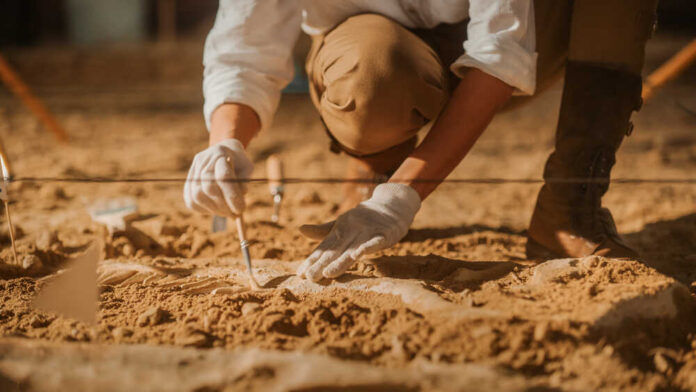
A New Jersey quarry has become America’s most prolific fossil site, preserving over 100,000 specimens from one of Earth’s most catastrophic extinction events in unique greensand soil that holds secrets to our planet’s ancient past.
Story Highlights
- Edelman Fossil Park contains over 100,000 fossils from 100+ species in a 7-inch extinction layer.
- Unique greensand soil preserved evidence from the asteroid impact that killed dinosaurs 66 million years ago.
- Scientists and philanthropists rescued the site from commercial development in 2015.
- The quarry now serves as a world-class research center and public education facility.
Ancient Catastrophe Preserved in New Jersey Soil
The Edelman Fossil Park in Mantua Township sits atop one of the most significant paleontological discoveries in North America.
The site preserves a remarkable seven-inch sedimentary layer from the Cretaceous-Paleogene extinction boundary, marking the exact moment 66 million years ago when an asteroid impact triggered the mass extinction that ended the age of dinosaurs.
This unique geological formation has yielded over 100,000 fossils from more than 100 species, making it one of the most fossil-dense sites globally.
The quarry’s exceptional fossil preservation stems from its distinctive greensand soil composition. Michael Root, a fossil preparator at the site, explains that New Jersey’s sandy, glauconitic greensand created ideal conditions for fossilization.
The bioturbated greensand deposits of the Hornerstown and Navesink formations concentrated remains in what scientists call the Main Fossiliferous Layer, creating a “death assemblage” that captures a snapshot of life during Earth’s fifth mass extinction event.
From Commercial Quarry to Scientific Treasure
For nearly a century, the site operated as a commercial quarry mining sandy soil for fertilizer use. The quarrying operations inadvertently exposed the fossil-rich layer, but scientific significance wasn’t fully recognized until the late 20th century. When the quarry closed in 2015, developers initially proposed commercial redevelopment.
However, paleontologists led by Dr. Kenneth Lacovara intervened, recognizing the site’s unparalleled scientific value as one of the few globally accessible K/Pg boundary locations with such abundant fossil content.
Rowan University acquired the property in 2016 with support from philanthropists Ric and Jean Edelman, whose funding secured the site’s transformation into a world-class research facility and museum. Dr. Lacovara promotes the location as a “Pompeii of dinosaurs,” emphasizing how it preserves a moment frozen in geological time.
The university’s intervention prevented the loss of this irreplaceable scientific resource to commercial interests, demonstrating the importance of preserving America’s natural heritage for future generations.
Advancing Scientific Understanding and Public Education
The Edelman Fossil Park now operates as both a cutting-edge research center and public education facility. Ongoing stratigraphic and taphonomic analysis continues yielding new fossil discoveries and insights into extinction processes.
Peer-reviewed studies detail the microstratigraphy of fossil layers, revealing unique sedimentary processes that concentrated and preserved specimens. The site’s research contributes significantly to global understanding of mass extinction events and fossil preservation mechanisms.
The museum offers public fossil digs and educational programs that engage local communities and schools in hands-on scientific discovery. This approach promotes science literacy while generating economic benefits through tourism and museum operations.
The facility serves as a model for balancing scientific research with public engagement, proving that preservation of natural sites can benefit both academic advancement and community education.
The site’s success demonstrates how private philanthropy and university stewardship can protect America’s geological treasures from commercial development while making them accessible to the public.
Sources:
Popular Mechanics (Michael Root interview)
Popular Mechanics (Dr. Kenneth Lacovara interview)