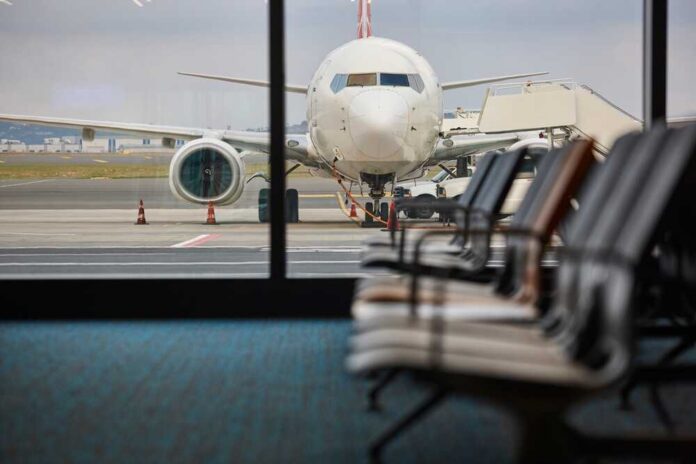
Air travel across the Northeast snapped back into motion after crews fixed the telecom lines that hobbled a key air traffic hub in Philadelphia.
Story Snapshot
- Transportation Secretary Sean Duffy said the lines were repaired and operations were resuming.
- A failure at the Philadelphia approach control center triggered widespread delays and ground stops.
- Repairs unlocked a staged recovery; delays lingered while schedules reset.
- Airports reported a clear turn from halt to restart late Monday.
What Broke And Why Flights Stopped
Federal aviation officials traced the disruption to the Philadelphia Terminal Radar Approach Control facility, which guides takeoffs and landings in dense Northeast airspace.
Reports described a two-hit failure: a primary communications circuit failed, and the backup fiber line had been cut offsite, removing the safety net the system needed to keep traffic flowing.
That double loss forced ground stops at major airports, including Newark, Philadelphia, and others in the New York region, as controllers lost standard data and voice routes used to manage approaches.
Airports began stacking delays as crews worked to restore the links. Cancellations, diversions, and long taxi times piled up, since each hour of constraints pushed more flights outside their planned slots.
The National Airspace System acts like a freeway at rush hour; one lane closure backs up miles of cars. Here, a control node slowed, so the queue stretched from the runways to the gates and into the broader network. That strain was predictable given the hub density between Philadelphia and New York.
How The Recovery Started
Transportation Secretary Sean Duffy announced Monday evening that the telecom lines had been repaired and that airport operations across the Northeast were resuming, while warning it would take time to clear the backlog.
Local and aviation outlets reported the same turn: once the damaged communications links were restored at Philadelphia, traffic managers lifted pauses in stages and reopened arrival and departure flows.
Newark and other airports moved from full stops to metered rates, which signals that controllers had regained the tools to sequence aircraft safely.
Newark has been hit hardest so far, with about 350 flights canceled — roughly a third of all scheduled operations. https://t.co/vBjdUFmekS
— Business Insider (@BusinessInsider) September 22, 2026
USA Today captured the transition in plain view. Flights resumed at some airports even as others still faced holds, showing a real but uneven climb-out from the outage. That pattern fits how air traffic control restores capacity after a technical fault.
The system does not flip from zero to full speed. It reopens on reduced rates, tests stability, and then adds volume step by step. Travelers felt that as rolling delays into the evening, even though the core failure had been fixed.
What “Operations Resuming” Means For Travelers
Officials used “operations resuming” to mean that the control system and airport pipelines were open again, not that every delay vanished at once. Airlines needed to re-crew flights, retime aircraft, and reconnect disrupted connections.
That work often takes several hours, sometimes longer, because crews time out, aircraft miss turns, and gates are jammed. Outlets on the ground warned of continued delays even after the green light returned, which matched Duffy’s caution about clearing the stack.
Duffy: Northeast airports resume operations after FAA grounded flights over telecom line cut by Amtrak worker –
Major airports across the Northeast were affected on Monday, including JFK and LaGuardia. According to Duffy, an Amtrak construction crew cut into a fiber line in New…
— Elena (@helen44767171) September 22, 2026
Readers who value order and safety will see the logic here. Controllers slowed or stopped inflows when communications backups failed. Crews repaired the lines. Managers restarted the system under control. That is how a safety-first network is supposed to behave.
The better test now is whether agencies publish clear lessons and strengthen route diversity so a single fiber cut cannot take out a backup. Several reports pointed to the dual-hit nature of the fault, which begs for hardened redundancy.
The Bottom Line
By Monday evening, the Northeast moved from standstill to restart after technicians restored communications serving the Philadelphia control hub. Airports reopened flows, though passengers still faced delays as schedules reset and crews rebalanced fleets.
Officials delivered the key outcome the public needed: a safe path to normal operations. Travelers got the other half of the truth: recovery takes time, but recovery was underway in full view across the major airports that had been hit.
Sources:
foxbusiness.com, abc17news.com, yahoo.com, whyy.org, brooklyn.news12.com, airwaysmag.com