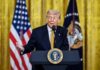

President Trump barred CNN, MS NOW, and Politico from the White House and enforced it the next day.
Story Snapshot
- Trump announced an immediate ban tied to “fake news” claims.
- Reporters from all three outlets were denied access the next day.
- The outlets and the White House Correspondents’ Association condemned the move.
- The fight revives long-running legal and political battles over viewpoint bias.
What Trump Announced, And How Fast It Took Effect
Trump said on September 18, 2026, that CNN, MS NOW, and Politico were banned from the White House “effective immediately.” He tied the move to what he called “constant ‘reporting’ FAKE NEWS!” and “cumulative stories” he views as false or unfair.
The White House treated it as a live policy, not a bluff. By the next day, reporters for those outlets were turned away at the gates. Security enforced the order on-site, confirming the ban was real and active.
Trump framed the ban as a quality-control measure, not a blanket attack on the press. He said the problem was repeated false coverage, not the outlets’ status. He did not release a list of specific articles or errors to justify the decision.
He also did not spell out the exact rule, such as credential revocation or grounds access limits. That gap created confusion about scope, yet the ground-level result was clear: no entry for those journalists.
How The Targeted Outlets Responded
CNN said the ban was an illegal assault on its constitutional rights and vowed to keep covering the White House and the federal government regardless of access limits. Politico said it would continue fair reporting and “vigorously defend” its First Amendment rights.
The White House Correspondents’ Association urged a reversal, arguing the Constitution protects press freedom from government interference and that such protection does not hinge on presidential approval of coverage.
The three outlets reported they were denied entry after the announcement, which matched wire and broadcast accounts. This swift turnaway became the clearest shared fact in a loud fight over motive. One side cast the move as necessary pushback against falsehoods.
The other cast it as retaliation for critical coverage. Neither side’s rhetoric settled the specific-evidence question about particular stories that were wrong.
🔊 CNN, MS NOW and Politico journalists say the White House confiscated their press passes after President Trump barred them from its grounds. Listen on the Reuters World News podcast https://t.co/XOJCOWGssf pic.twitter.com/YY2BCW8lCF
— Reuters (@Reuters) September 20, 2026
The Legal And Historical Guardrails
Courts have long warned the government against viewpoint discrimination in spaces the White House opens to the press.
In recent Associated Press litigation, the United States Court of Appeals for the District of Columbia Circuit described Oval Office and similar spaces as nonpublic forums where the White House still cannot restrict access based on viewpoint.
A federal judge also wrote that if the government opens doors to some journalists, it cannot close them to others for their views.
These rulings do not give any outlet a right to be “in the room where it happens” at all times, but they do place heavy weight against singling out reporters for their stance.
That is why the lack of a public record naming specific errors hurts the White House’s legal and public case. If the ban rests only on disliking coverage, courts tend to see that as viewpoint targeting. If it rests on neutral rules tied to conduct or security, it stands on stronger ground.
What This Means For Conservatives, And What Comes Next
Conservatives want a press that reports facts, not narratives. They also want the government to follow the Constitution, even when the press frustrates them. The cleanest path is to set clear, neutral access standards, publish them, and enforce them evenly.
If the White House can point to rule violations, it will have a firmer case. If it cannot, the fight shifts from correcting errors to punishing viewpoints, and that invites legal setbacks and needless distraction.
Sources:
cnbc.com, cnn.com, reuters.com, abcnews4.com, nbcnews.com, nypost.com, usatoday.com, dw.com