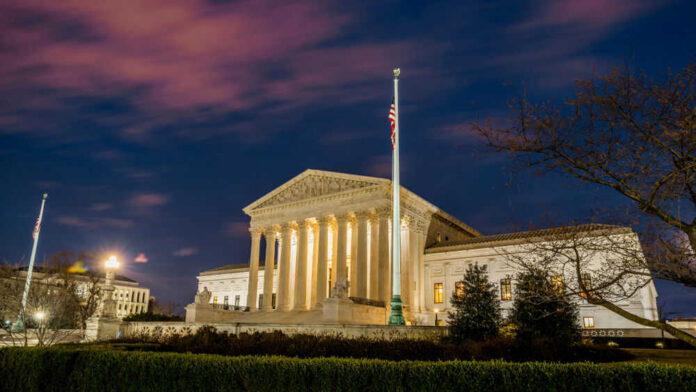
The Supreme Court just cleared the way for California to deploy a voter-approved map that could flip up to five Republican-held House seats—right as the 2026 fight for congressional control heats up.
Quick Take
- The Supreme Court denied an emergency request from California Republicans and the Trump administration to block California’s new congressional map for 2026.
- California’s Proposition 50 map was approved by voters in a special election and is expected to advantage Democrats in several districts.
- Lower-court judges said the evidence showed “overwhelming” partisan motivation, while the racial-gerrymandering evidence was “exceptionally weak.”
- The decision comes amid a national redistricting escalation that began after Texas adopted a GOP-favoring map in 2025.
Supreme Court greenlights California’s Prop 50 map for the 2026 midterms
On February 4, 2026, the U.S. Supreme Court issued a brief, unsigned order refusing to block California’s new congressional map, known as Proposition 50. California Republicans, joined by the Trump administration, had asked the court for emergency relief to stop the map from being used in the 2026 midterm elections.
With the Court’s denial—and no noted dissents—California will move forward with districts that Democrats say better reflect the state’s electorate.
Supreme Court allows new California congressional districts that favor Democrats https://t.co/LCji6EbGGk
— New York Daily News (@NYDailyNews) February 4, 2026
The immediate effect is practical and political: candidate filing and campaigning are already underway, and the lines on the ballot are now effectively locked in for 2026. California officials argued that changing the rules late in the cycle would inject confusion and administrative disruption into an election already in motion.
The Court’s refusal to intervene means campaigns will proceed under Prop 50’s boundaries, even as broader questions about fairness and motive remain contested.
A partisan tit-for-tat that mirrors the Texas fight
California’s map fight did not emerge in a vacuum. In November 2025, Texas adopted a new congressional map intended to favor Republicans and potentially net the GOP additional House seats—an aggressive mid-cycle move that intensified national pressure on redistricting.
California voters then approved Proposition 50 in a special election on November 4, 2025, with about 64% voting “yes” out of roughly 11 million ballots cast. The stated rationale was blunt: counterbalance Texas’ gains.
That kind of escalation is exactly what frustrates Americans who expect elections to be about persuading voters instead of engineering outcomes. The Supreme Court’s modern precedent also limits what federal courts can do about pure partisan gerrymandering, pushing many challenges into narrow legal channels.
Since the Court has said partisan gerrymandering claims are generally not justiciable in federal court, litigants often recast disputes as racial-gerrymandering cases—because racial discrimination claims remain reviewable under federal law.
What the courts said about race versus politics
California Republicans sued soon after Prop 50 passed, initially attacking the map as an unconstitutional racial gerrymander across multiple districts. A three-judge federal panel in Los Angeles declined to block the map, ruling 2–1 against the challengers.
The majority concluded the record showed “overwhelming” evidence the lines were driven by partisan goals, while evidence that race predominated was “exceptionally weak.” That distinction mattered because partisan line-drawing, by itself, is harder to stop in federal court.
The Trump administration’s filings argued that partisan intent cannot be used as a free pass for racial sorting, even if politicians are also chasing electoral advantage. Challengers also pointed to an outside consultant’s social media comments as proof the mapmakers were focused on boosting Latino political power.
Even with those arguments on the table, the Supreme Court ultimately declined emergency intervention, leaving the lower-court decision intact and Prop 50 in effect for the midterms.
The “Purcell” timing rule and why late changes rarely succeed
One of California’s central defenses leaned on the Supreme Court’s caution about last-minute election changes, often referenced as the “Purcell principle.” The idea is straightforward: courts should hesitate to alter election rules close to an election because doing so can confuse voters, burden administrators, and destabilize ongoing campaigns.
California told the justices that candidate filing had already started and that the state needed clarity—not court-ordered turbulence—heading into 2026.
That timing logic also interacts with the Court’s recent redistricting posture. In December 2025, the Supreme Court allowed Texas’ new map to proceed for 2026, despite ongoing disputes and concerns raised in lower-court litigation.
In that Texas matter, Justice Samuel Alito wrote separately to note the partisan incentive behind both states’ actions. With the Court now letting California’s map stand too, the practical message is that once a cycle is moving, judges are reluctant to hit the brakes.
What it means for House control—and why conservatives should watch closely
Analysts across outlets have described Prop 50 as capable of flipping as many as five Republican-held seats, a potentially decisive shift given the narrow margins that often determine House control.
That does not guarantee outcomes—voters still decide—but it shapes the battlefield in ways that can advantage one party before a single ballot is cast. For conservatives, the bigger issue is the precedent: when states openly redraw lines midstream as retaliation, the country drifts further from stable rules.
The Supreme Court on Wednesday allowed California to use a new voter-approved congressional map that is favorable to Democrats in this year’s elections, rejecting a last-ditch plea from state Republicans and the Trump administration.https://t.co/BnDdejrX7I
— FOX26 News (@KMPHFOX26) February 4, 2026
At the same time, the record in this case underscores a limitation worth stating plainly: the key federal-court findings emphasized partisan motivation and found the racial evidence weak, which made a successful emergency challenge harder under current doctrine.
That leaves voters with a familiar reality—politicians and activists will keep gaming district lines where they can, and the courts may only step in for the clearest legal violations. With 2026 approaching fast, national attention now shifts from lawsuits to turnout.
Sources:
Supreme Court allows new California congressional districts that favor Democrats
The Supreme Court lets California use its new Democratic-friendly congressional map
California asks Supreme Court to reject GOP map challenge