
America just re‑locked Iran’s ports and helped turn the world’s busiest oil choke point into a test of will between missiles, lawyers, and nervous markets.
Story Snapshot
- U.S. Central Command says Iran hit three commercial ships in the Strait of Hormuz, breaking a ceasefire.
- Washington answered with new strikes and a renewed naval blockade that targets traffic to and from Iranian ports.
- Iran fired back and moved to close the strait again, claiming the U.S. blockade itself violates the deal.
- Oil markets, global shipping, and the legal rules of the sea are all now caught in the middle.
How three ships turned a fragile ceasefire into a blockade
The latest crisis began when three merchant vessels were struck by projectiles while they crossed the Strait of Hormuz, a narrow waterway that carries about a fifth of the world’s traded oil. U.S. Central Command said Iran’s forces attacked the ships and called it “unwarranted, dangerous” aggression and a “clear violation” of the ceasefire.
A U.S. official told reporters the goal of the response was to impose “heavy costs” for targeting civilian crews in an international waterway. Qatar blamed Iran for one hit on its large liquefied natural gas tanker, saying a drone strike set the engine room on fire. British naval monitors received reports from a tanker near Oman that an unknown projectile caused a blaze on board.
That mix of direct claims and cautious language shows why skeptics keep asking for hard proof like missile fragments or satellite tracks rather than just statements, but the pattern fits months of Iranian threats against shipping in the area.
Washington did not just fire back; it changed the rules of the game. Within hours of the attacks, the U.S. revoked a special license that had allowed Iran to sell oil under the ceasefire arrangement.
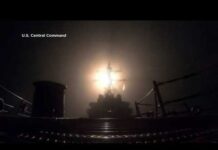
Central Command then announced “powerful strikes” on Iranian military targets, hitting more than 80 sites, including air defenses, command hubs, anti‑ship missile units, and over 60 Islamic Revolutionary Guard Corps small boats meant to harass commercial ships.
These moves fit a broader U.S. view rooted in common sense: if a regime uses force to threaten free trade and innocent sailors, it should face real military and economic pain, not more loopholes. To many Americans, that is not “escalation for its own sake”; it is basic deterrence against a repeat offender in a vital lane for global commerce.
What a U.S. blockade of Iranian ports really looks like
The naval blockade itself is not a slogan; it is a set of orders and patrol patterns stretching across the Gulf. Central Command previously said the blockade covers “the entirety of the Iranian coastline” and applies to all ships sailing to or from Iranian ports, warning that unauthorized vessels can be intercepted, diverted, or captured.
At the same time, U.S. officials stress that ships going to non‑Iranian ports are not supposed to be blocked as they pass through the Strait of Hormuz. In practice, however, blockade enforcement means American warships sit close enough to Iranian waters to stop or seize suspect vessels, which raises the risk of miscalculation.
One earlier incident saw U.S. aircraft disable two Iranian‑flagged tankers that were judged to be trying to slip into a blocked port. That kind of kinetic enforcement pushes a ceasefire into a gray zone, a “war of blockades” where shots are fired but neither side admits the truce is dead.
President Trump says military strikes against Iran will continue "until I say it's enough."
In an exclusive interview with FOX News chief foreign correspondent @TreyYingst on @SpecialReport, Trump was asked whether his objectives in Iran would require U.S. ground forces.
"The… pic.twitter.com/rlvHFgkvZj
— Fox News (@FoxNews) July 14, 2026
Critics in the media and some foreign capitals say this cross‑between‑war‑and‑peace makes the blockade legally shaky. International shipping officials have argued that tolls or special fees on a key strait have “no legal basis,” and some analysts extend that logic to question whether a unilateral blockade during a ceasefire complies with maritime law.
Even inside the United States, figures like Mike Pence and Mike Pompeo have reportedly raised doubts about how long such a blockade can last without a clear path to victory or a stable peace.
From an American viewpoint, that criticism misses a central point: Iran has used mines, missiles, and drones to threaten free passage for everyone, not just U.S. enemies. When a state turns a shared waterway into a weapon, doing nothing is also a decision – one that rewards aggression and invites copycats.
Iran’s counter‑story: the real violator is the blockade
Tehran counters with a very different story. Iranian leaders say they do not recognize the Islamabad memorandum of understanding that underpins the U.S. charge of a “violation,” arguing that Washington broke the spirit of the deal first by enforcing a naval blockade while the ceasefire was supposed to hold.
Iranian commanders insist they have the right to control shipping lanes that run off their coast and declare that U.S. efforts to open new routes through the strait are a breach of agreed rules.
State media claimed that the Qatari liquefied natural gas tanker was attacked only after it ignored warnings, hinting that it strayed from an approved path but avoiding a clear admission of responsibility.
Iran’s Revolutionary Guard navy has now announced the strait is “closed again,” warning that any vessel that approaches will be treated as cooperating with the enemy and could be targeted. In this telling, the blockade is not deterrence; it is economic warfare that “holds the global economy hostage.”
Trump reviewing plans for devastating attacks against Iran beyond Hormuz strikes
——
US President Donald Trump convened a Situation Room meeting on Tuesday to consider a far broader offensive against Iran, with plans reportedly extending beyond current strikes around the Strait of… pic.twitter.com/8Z0ANeXEet— The Cradle (@TheCradleMedia) July 15, 2026
Iran’s narrative has weak spots that matter. Tehran has not released forensic evidence to contradict U.S. claims about missiles and drones, nor has it offered detailed crew testimony from attacked ships that would clearly blame another actor.
It also focuses its anger on the blockade while mostly sidestepping Washington’s specific allegation that three distinct commercial vessels, including a Saudi‑flagged crude tanker and a large Qatari gas carrier, were hit inside or near an international strait.
From a common‑sense standpoint, that looks less like a clean legal defense and more like an attempt to change the subject. At the same time, the lack of publicly shared missile fragments or launch imagery from either side keeps room for doubt, which foreign critics and Iran’s supporters use to frame the U.S. actions as heavy‑handed and politically driven rather than strictly defensive.
The bigger stakes: markets, rules, and future copycats
Behind the headlines, the numbers are sobering. Since the current conflict began, ship‑tracking data shows hundreds of vessels crossing Hormuz, with roughly one in every 13 attacked. The International Maritime Organization confirmed nine attacks in just one week early in the year, leaving seven people dead.
Lloyd’s List analysis suggests these hits are random with respect to flag or cargo type and are calibrated mainly to disrupt shipping. Every new blockade or closure thus ripples far beyond U.S.‑Iran rivalry, feeding oil price spikes – one recent surge topped 10 percent in a single day – and shaking markets already uneasy about war and inflation.
For Americans who care about strong borders, reliable energy, and clear rules, the danger is simple: if Iran can weaponize a chokepoint and face only speeches, other hostile regimes will take notes. But if the United States answers every attack with open‑ended blockades and strikes without a clear finish line, the country risks drifting into permanent crisis management.
The current showdown over Hormuz is not just about three damaged ships; it is a live test of whether decisive action can protect free commerce without turning the world’s key waterways into forever wars.
Sources:
apnews.com, npr.org, cnn.com, aljazeera.com, cnbc.com, youtube.com, usnews.com, nytimes.com, reuters.com, theguardian.com, cbc.ca, bbc.com, scrippsnews.com, en.wikipedia.org, reddit.com