

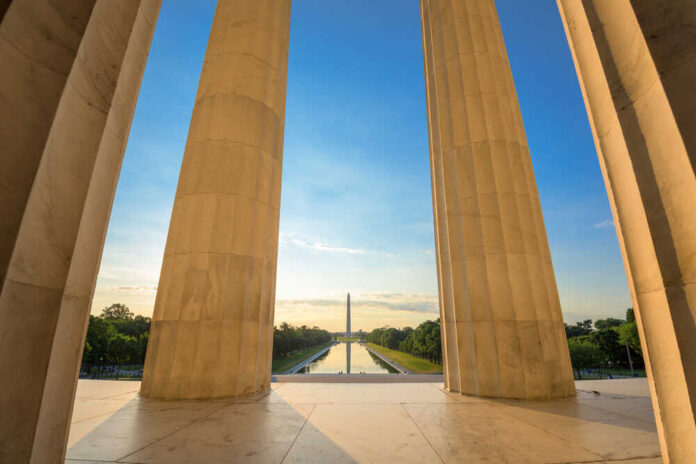
The fight over a single shade of blue at the Lincoln Memorial is really a fight over whether federal power still has to follow federal law.
Quick Take
- A preservation nonprofit sued to stop the National Park Service from repainting the Reflecting Pool basin “American Flag Blue” without the review process required for historic sites.
- The lawsuit targets the Trump administration, the Department of the Interior, the National Park Service, and Interior Secretary Doug Burgum, seeking an emergency halt through a temporary restraining order.
- The legal flashpoint is Section 106 of the National Historic Preservation Act, which requires consultation and review before altering protected historic properties.
- Supporters frame the change as patriotic “beautification” and improved maintenance; critics argue it’s an irreversible redesign of a nationally significant landscape.
A Historic Landmark Becomes a Live Construction Zone
The Cultural Landscape Foundation filed suit in federal court in Washington, D.C., aiming to stop ongoing work at the Lincoln Memorial Reflecting Pool.
The group argues that the government pushed ahead with resurfacing, including painting the basin “American Flag Blue” and adding a filtration system, without completing the legally required preservation review.
The pool sits within the National Mall Historic District, a protected site whose design choices were intentional rather than decorative afterthoughts.
The change sounds cosmetic until you picture what the pool exists to do: deliver a controlled, mirror-like reflection of the Lincoln Memorial and the Washington Monument.
A 1999 National Park Service report described how the original dark surface created the illusion of depth and a stronger reflection.
That’s not nostalgia; it’s optics and architecture working together. Alter the basin color and you change the entire visual effect millions associate with the Mall.
Section 106: The Part Everyone Skips Until Court
Section 106 of the National Historic Preservation Act functions like a mandatory checklist for federally connected projects that could affect historic properties.
It demands review and consultation, including public input, before the government commits to a course that changes protected places.
The lawsuit claims the administration bypassed that process and moved equipment in anyway. That matters because once paint cures and the surface changes, “review later” becomes a hollow promise.
Preservation law frustrates people who want quick results, but it exists for a reason conservatives usually appreciate: predictable rules that bind the government itself.
If a federal agency can treat statutory safeguards as optional when a project feels politically urgent or symbolically attractive, the precedent won’t stay limited to one reflecting pool.
The next shortcut could land on a battlefield marker, a historic church, or a small-town monument with fewer lawyers watching.
President Trump pledged to clean up the “filthy” reflection pool outside the Lincoln Memorial in anticipation of the nation’s 250th birthday this Independence Day — and drove through the reflection pool to inspect the progress himself. pic.twitter.com/YAeCiaCeXm
— New York Post (@nypost) May 8, 2026
Trump’s “American Flag Blue” Pitch Meets a Preservation Wall
President Trump publicly criticized the pool’s original gray as “never good” and promoted the repainting as part of a broader “beautification” push in Washington.
The administration also tied the work to maintenance goals like algae reduction, arguing filtration and a new surface would improve clarity. A maintenance rationale can be legitimate.
The question the lawsuit raises is whether the government can claim maintenance while skipping the very review designed to distinguish between upkeep and redesign.
Cost has also become part of the story. Early estimates reportedly came in under $2 million, but later reporting pegged the project far higher, around $14 million.
Big government projects inflate for many reasons, and cost overruns don’t prove wrongdoing on their own.
They do intensify the public’s right to ask basic questions: Who approved what, when, under which authority, and with what opportunity for public comment?
Why Color Choice Isn’t Trivial at a National Symbol
The Reflecting Pool isn’t just a scenic rectangle of water. It’s a national stage: a place tied to public memory, including civil rights history and mass gatherings where the setting amplifies the message.
People don’t travel to the Mall to see what a current administration thinks looks sharper on TV; they go to stand inside a shared civic inheritance. That’s why preservationists treat “American Flag Blue” as more than a paint chip.
Supporters of the repaint will say the pool belongs to the American people right now, not to museum curators or nonprofits.
Still, it draws a line between debating taste and ignoring process. If the administration believes the new look is worth it, the strongest move is to win the argument in daylight through the required review, not outrun it with contractors.
The Court Clock: Temporary Restraining Order or Done Deal
The lawsuit asks for emergency relief because timing is the leverage. Once a surface gets coated, scraped, or sealed, restoration becomes harder, pricier, and sometimes impossible.
The case landed with Judge Carl Nichols, and the immediate question is whether he sees enough risk of irreparable harm to pause the work while the legal merits play out. Until a judge orders otherwise, the administration appears positioned to keep moving.
This clash also previews a broader Washington pattern: executive ambition running into statutory guardrails. Some typically want the administrative state smaller, but also want it lawful and bound by text, not vibes.
A win for the government based on “we meant well” would weaken the idea that agencies must follow Congress’s rules.
A win for the preservationists would not settle the aesthetic debate; it would force the debate into the process Americans already agreed to.
Lawsuit seeks to stop repainting of Lincoln Memorial Reflecting Pool https://t.co/FqJJYyP3lv
— ABC7 Eyewitness News (@ABC7) May 12, 2026
Whatever the final color ends up being, the more important outcome is whether the public gets a seat at the table before iconic places change. A reflecting pool is supposed to mirror a monument, not the mood of the moment.
If Washington can repaint history first and ask permission later, the real stain won’t be blue—it’ll be the quiet erosion of accountability that every taxpayer eventually pays for.
Sources:
Lawsuit seeks to stop repainting of Lincoln Memorial Reflecting Pool
Nonprofit sues the federal government over plans to paint Lincoln Memorial Reflecting Pool blue