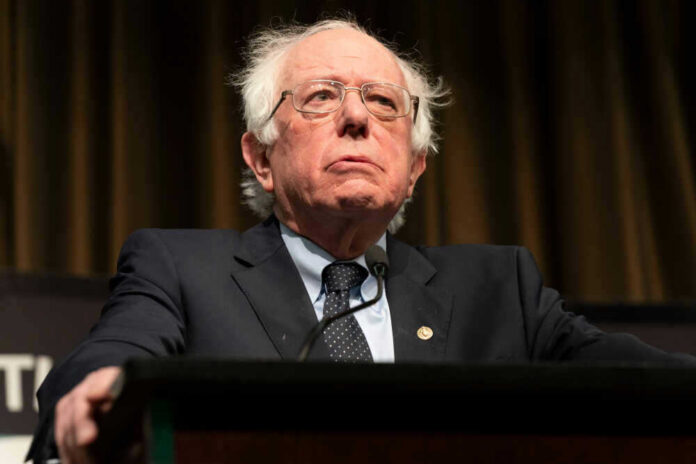
Senator Bernie Sanders put a number on the table—half the stock of the biggest artificial intelligence firms—then said it should pay every American, every year.
Story Snapshot
- Proposal: a one-time 50 percent equity tax on large artificial intelligence companies to seed a national wealth fund.
- Governance: a seven-member, Senate-confirmed commission would hold voting shares and board seats.
- Structure: forced separation of artificial intelligence units from other business lines at qualifying firms.
- Scale and stakes: Sanders cites up to $7 trillion over a decade and warns of mass job loss from artificial intelligence.
What The Bill Actually Does, In Plain Terms
The American Artificial Intelligence Sovereign Wealth Fund Act requires the largest artificial intelligence companies, defined as those with at least $200 million in annual artificial intelligence sales, to transfer a one-time 50 percent equity stake to the public fund.
This is not a profits tax; it is stock. The bill mandates structural separation so the public stake applies only to artificial intelligence operations, not unrelated lines of business. Sanders’ office says the fund could reach $7 trillion over ten years, then pay an annual dividend to every resident.
The fund’s money could not be used to bail out artificial intelligence companies, a boundary meant to guard taxpayers if markets stumble. Management would sit with an Independent Commission for Democratic Artificial Intelligence.
The White House would nominate seven commissioners, and the Senate would confirm them. Those commissioners would vote the shares and could place representatives on company boards, with the stated aim to block decisions that harm the public.
Why Sanders Says This Now
Sanders ties the push to two forces: concentrated power in the hands of a few firms, and the fear of sweeping job loss. He cites a Senate Health, Education, Labor, and Pensions Committee estimate that artificial intelligence could replace nearly 100 million American jobs in the next decade.
He points to global examples to make the concept feel normal, referencing Norway’s roughly $2 trillion sovereign wealth fund and Alaska’s dividend program as models for sharing resource wealth with citizens.
Majority of U.S. workers support an AI wealth fund as tech layoffs surge, survey finds https://t.co/dIKWDnHuGf
— CNBC (@CNBC) July 12, 2026
He also notes friendly signals from inside the sector. He says OpenAI floated a public wealth fund concept, and Anthropic has mentioned national funds with public stakes in the growth of artificial intelligence.
That claim gives the plan a business-adjacent gloss, even as the bill would force equity transfers. Whether those firms would back a mandated half-ownership move is a separate question the bill does not solve on its face.
How The Fund Would Hold Power
The commission would own and vote shares. That turns the public from a passive observer into a shareholder with a say. The bill text summary frames voting power as a tool to stop actions that would harm Americans, such as reckless deployment or corner-cutting on safety.
Forced separation between artificial intelligence and non-artificial intelligence units aims to keep the fund’s hand clean and targeted, so the public stake governs artificial intelligence choices without distorting other company operations.
This structure echoes a simple test: align incentives with the people who bear the risk. If artificial intelligence rewires job markets and security norms, the public should have a seat at the table where decisions are made. That is the bet. The counterweight is size.
A fast-growing sector, a new commission, and board seats add friction. That can slow bad moves—and good ones, too, if governance turns political.
Open Questions That Could Make Or Break It
The proposal’s math and mechanics draw the hardest questions. Sanders’ materials cite up to $7 trillion over ten years and a five percent dividend, yet a $1,000 payment to about 335 million people would take about $335 billion per year.
That leaves a large sum unassigned in public materials, raising clarity issues on use of funds and reinvestment plans. Skeptics will ask for independent modeling to vet the valuation and dividend path.
🚨69% OF AMERICANS SUPPORT FORCING AI FIRMS TO GIVE 50% STOCK TO PUBLIC FUND!
A new Verasight survey finds strong backing for requiring major AI companies to transfer half their shares into a public sovereign wealth fund, especially amid ongoing tech layoffs and corporate… pic.twitter.com/6Yvi3Djijr
— Crypto Banter (@crypto_banter) July 12, 2026
Legal force is another hinge. The summary describes a one-time 50 percent equity transfer, including for private firms that do not trade on public markets. The summary and press materials do not outline valuation rules, dispute resolution, or enforcement for private companies like OpenAI or Anthropic.
Without full statutory text, analysts cannot test the plan against constitutional limits or practical compliance pathways. Congress has only the introduction on file, with no schedule for hearings or a vote.
The Political Road And The Historical Pattern
Congress has seen ideas like this before in moments of disruption. The Alaska Permanent Fund stands as the lone American case where a resource-based public stake with dividends stuck. Many other proposals, from oil to digital platforms, drew headlines and stalled.
Sanders’ plan fits that pattern: high ambition, a fairness pitch, and a steep climb through constitutional review and committee politics. The plan’s ban on bailouts, its focus on dividends, and its tight scope to artificial intelligence all aim to answer familiar critiques.
Clear math, legal footing for equity transfers, and a governance charter that is firm, boring, and insulated from fads would decide whether this fund feels like ownership with responsibility—or a fight destined for the courts and the cutting room.
Sources:
cnbc.com, sanders.senate.gov, congress.gov, rollcall.com