
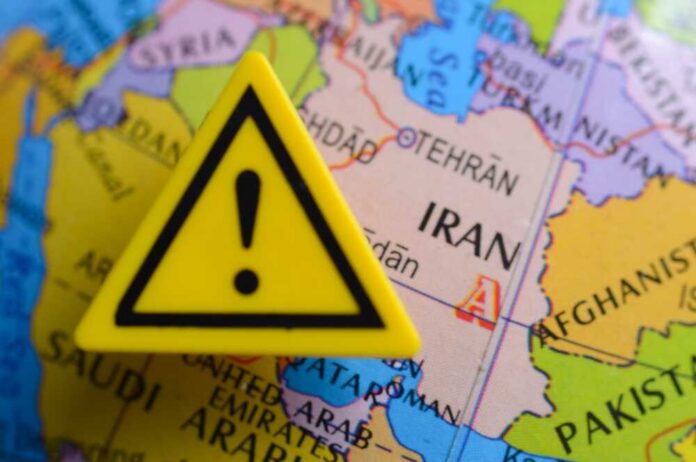
While Trump declared Iran was “negotiating on fumes,” U.S. Central Command was already pulling the trigger on a fresh round of strikes — and Iran was firing back.
Story Snapshot
- U.S. forces shot down four Iranian one-way attack drones near the Strait of Hormuz, then struck the ground control station in Bandar Abbas preparing to launch a fifth.
- Iran retaliated by targeting a U.S. military base, while simultaneously claiming the U.S. strikes violated an existing ceasefire.
- Trump’s “negotiating on fumes” remark framed Iran as desperate at the table, even as both sides exchanged live fire.
- The broader context includes U.S. Air Force and Navy strikes on three Iranian nuclear facilities on June 22, 2025, as part of what has been called the Twelve-Day War.
What U.S. Central Command Actually Did and Why
U.S. Central Command forces intercepted four Iranian one-way attack drones that posed a direct threat around the Strait of Hormuz. [1] After neutralizing those four, American forces identified a fifth drone being prepared for launch at an Iranian ground control station in Bandar Abbas, a strategic port city on Iran’s southern coast.
Rather than wait, U.S. forces struck the station before it could fire. [8] The Pentagon described the action as defensive. That word choice matters enormously in international law and domestic politics — and both sides know it.
NEW: CENTCOM says Iran carried out an “egregious ceasefire violation” overnight, launching a ballistic missile toward Kuwait and multiple attack drones near the Strait of Hormuz.
The missile was intercepted by Kuwaiti forces while the U.S. took out five drones and prevented a… pic.twitter.com/kvqb542Za7
— Fox News (@FoxNews) May 28, 2026
Iran’s response was immediate and predictable. Tehran launched missiles at a U.S. military base in retaliation, while Iranian authorities publicly claimed the U.S. strikes hit nothing more than a barren area outside Bandar Abbas. [2] That counterclaim conveniently serves two audiences at once: it dismisses American military effectiveness for domestic consumption while framing the U.S. as the aggressor for international observers. Iran has run this playbook before, and it works well enough to muddy the waters every single time.
Trump’s “Negotiating on Fumes” Comment Was Strategic, Not Casual
Trump’s public declaration that Iran was “negotiating on fumes” was not an offhand remark. It was a calculated signal designed to project American dominance at the negotiating table while military pressure was being applied simultaneously. [3]
This kind of coordinated messaging — diplomatic taunting paired with kinetic action — is consistent with a maximum pressure doctrine that treats economic, military, and rhetorical tools as a single integrated instrument. Whether it accelerates a deal or hardens Iranian resolve is the central question no one can answer cleanly right now.
The broader military backdrop makes Trump’s framing more credible than Iran would like to admit. On June 22, 2025, U.S. Air Force and Navy assets struck three Iranian nuclear facilities during what has since been referred to as the Twelve-Day War. [4] Iran’s nuclear program, its primary source of leverage and prestige, took direct hits from the most advanced military in the world. Calling that “negotiating on fumes” is not bluster — it is a fairly accurate description of Iran’s diminished hand.
The Ceasefire Claim Is the Most Dangerous Part of This Story
Iran’s assertion that U.S. strikes violated a ceasefire deserves scrutiny rather than dismissal. [8] The U.S. said the broader ceasefire remained in place even after the Bandar Abbas strike, essentially arguing that targeting an active drone launch site is a force protection action, not a ceasefire breach.
That legal and strategic distinction is thin enough to collapse under pressure. If both sides are conducting strikes while simultaneously claiming a ceasefire exists, the ceasefire is a fiction — and fictions have a way of ending badly in the Strait of Hormuz.
The US military executed a precision strike against an Iranian ground control station in Bandar Abbas.
CENTCOM forces intercepted four attack drones before striking the facility as it prepared a fifth launch.
Iranian state media downplayed the hit, claiming they only fired… pic.twitter.com/goSytHSJNj
— The UAE Times (@theuaetimes) May 28, 2026
This exchange fits a structural pattern that has defined U.S.-Iran confrontations for decades. Both governments have powerful incentives to label their own moves as defensive and reactive. [1] The U.S. needs to justify force protection actions to allies and to Congress. Iran needs to portray American strikes as illegal aggression to maintain regional credibility and domestic legitimacy.
The result is a fog of competing narratives where the facts on the ground — drones launched, stations struck, bases hit — get buried under the spin. What remains clear is that American forces are acting, Iran is retaliating, and the negotiating table is somehow still standing. For now.
Sources:
[1] Web – US military conducts another strike against Iran after Trump says Iran …
[2] YouTube – U.S. strikes Iranian military facility and four drones amid fragile …
[3] YouTube – U.S. launches fresh ‘defensive’ strikes against Iran, Tehran hits back
[4] YouTube – US military conducts another strike against Iran
[8] Web – 2019 Iranian shoot-down of American drone – Wikipedia