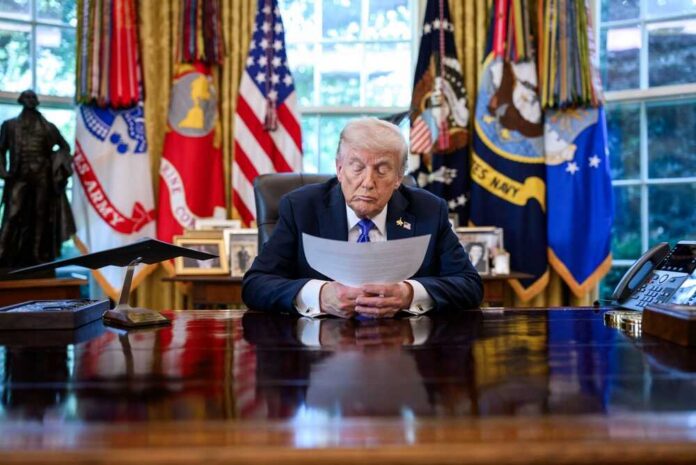
BREAKING UPDATE: TRUMP HAS CANCELED TODAY’S CAMP DAVID MEETING AND WILL HOLD IT AT THE WHITE HOUSE.
A rare presidential-level Cabinet session at Camp David signals the Iran talks are in a pressure-cooker phase, but the facts leave just enough fog to keep everyone guessing.
Story Snapshot
- A publicly announced, unusual Camp David Cabinet meeting is tied to active talks with Iran [1][4].
- Reporters describe the negotiations as entering a critical phase, not a routine calendar hold [1].
- The official Camp David role as a presidential retreat cautions against overreading the venue alone [3].
- Public readouts remain sparse, creating a vacuum filled by symbolism and speculation [1][4][3].
What the rare Camp David session actually tells us
Fox News framed the Wednesday gathering as a rare Cabinet meeting at Camp David staged while negotiations with Iran reached a “critical phase,” a signal that the White House wants principals aligned and options sharpened before decisions harden [1].
CBS News directly linked the meeting to Iran diplomacy, quoting the president’s “nicely” descriptor about progress, which indicates at least a perceived opening worth elevating to presidential bandwidth [4]. Those on-the-record scheduling and framing choices carry weight because leaders use venue and timing to send policy signals.
President Trump is expected to take the unusual step of holding a Cabinet meeting at Camp David on Wednesday, The Washington Times has confirmed. https://t.co/CDCGgU4fnr
— The Washington Times (@WashTimes) May 26, 2026
Camp David’s track record reinforces the message discipline. Presidents reserve it for consequential huddles, not for show-and-tell. Axios previously reported a marathon strategy session there on Iran and Gaza with the full foreign policy team, the kind of meeting that precedes or follows real inflection points in pressure campaigns and negotiating gambits [5].
When a president drags every senior hand to the mountain, it usually means the whiteboards get messy with best-case and worst-case pathways, and staff leave with marching orders, not talking points.
Why symbolism can mislead without an official readout
The White House’s own description of Camp David as a presidential retreat used extensively for hosting foreign leaders reminds analysts to separate theater from substance [3]. A high-prestige site can build leverage at the table, but the location alone does not prove a breakthrough, red line, or ceasefire shift.
Without a readout that lists decisions, directives, or new terms, the record shows a sensitive meeting happened, not what the principals locked in. Reporters therefore lean on urgency markers that may outpace verifiable outcomes [1][4].
That dynamic explains the current split-screen. One side infers a decisive turn because rare meetings correlate with major moves. The other side says: prove it. Both impulses are rational. In complex negotiations, presidents often escalate attention before a result exists to increase discipline at home and signal resolve abroad. The smarter inference is conditional: the meeting raises the probability of policy movement, yet the magnitude and direction remain unconfirmed until officials publish decisions or negotiators surface terms.
Reading the tea leaves through common sense
A full Cabinet-level session at Camp David during a claimed “critical phase” suggests a bid to align those fundamentals: define acceptable end states, pressure-test enforcement, and prevent mission creep [1].
That approach tracks with a negotiation model that prizes peace through strength—diplomacy backed by pressure and preparedness. The Axios account of earlier deep-dive strategy work at Camp David fits that template, emphasizing structured deliberation before public commitments [5].
US President Trump has convened a cabinet meeting at Camp David to discuss the ongoing US-Iran peace negotiations, suggesting a significant and decisive phase in the talks. The meeting comes as the US and Iran appear to be moving closer to a potential end to their conflict, with…
— Tegu breaking news. (@tegufy_news) May 26, 2026
Patience beats headline-chasing here. The rolling chronology captures the wider arc of United States–Iran contacts, but encyclopedic timelines can blur rumor and outcome while events are still moving [2]. The better compass is the pairing of high-level time investment with disciplined public messaging.
When presidents convene rare strategy sessions and keep specifics tight, they are either finalizing a deal architecture or calibrating a firmer pressure track. Either path demands Cabinet consensus and interagency synchronization before the next shoe drops.
Sources:
[1] Web – Trump calls rare Camp David Cabinet meeting amid critical Iran talks
[2] Web – 2025–2026 Iran–United States negotiations – Wikipedia
[3] Web – Camp David – The White House
[4] Web – Trump to hold Cabinet meeting at Camp David on Wednesday
[5] Web – Trump discussed Gaza, Iran goals at Camp David strategy session